
Aprendizaje y formación · CUADERNO DE IDEAS
Richard Feynman and the Learning Method of Explaining Ideas in Your Own Words
Discover the Feynman technique: explain an idea simply, find gaps in your understanding, return to your sources, and refine your explanation.
LECTURA EN VOZ ALTA
Escucha este artículo
Puedes escucharlo mientras haces otras actividades. Elige una voz y ajusta la velocidad.
Preparado para escuchar.
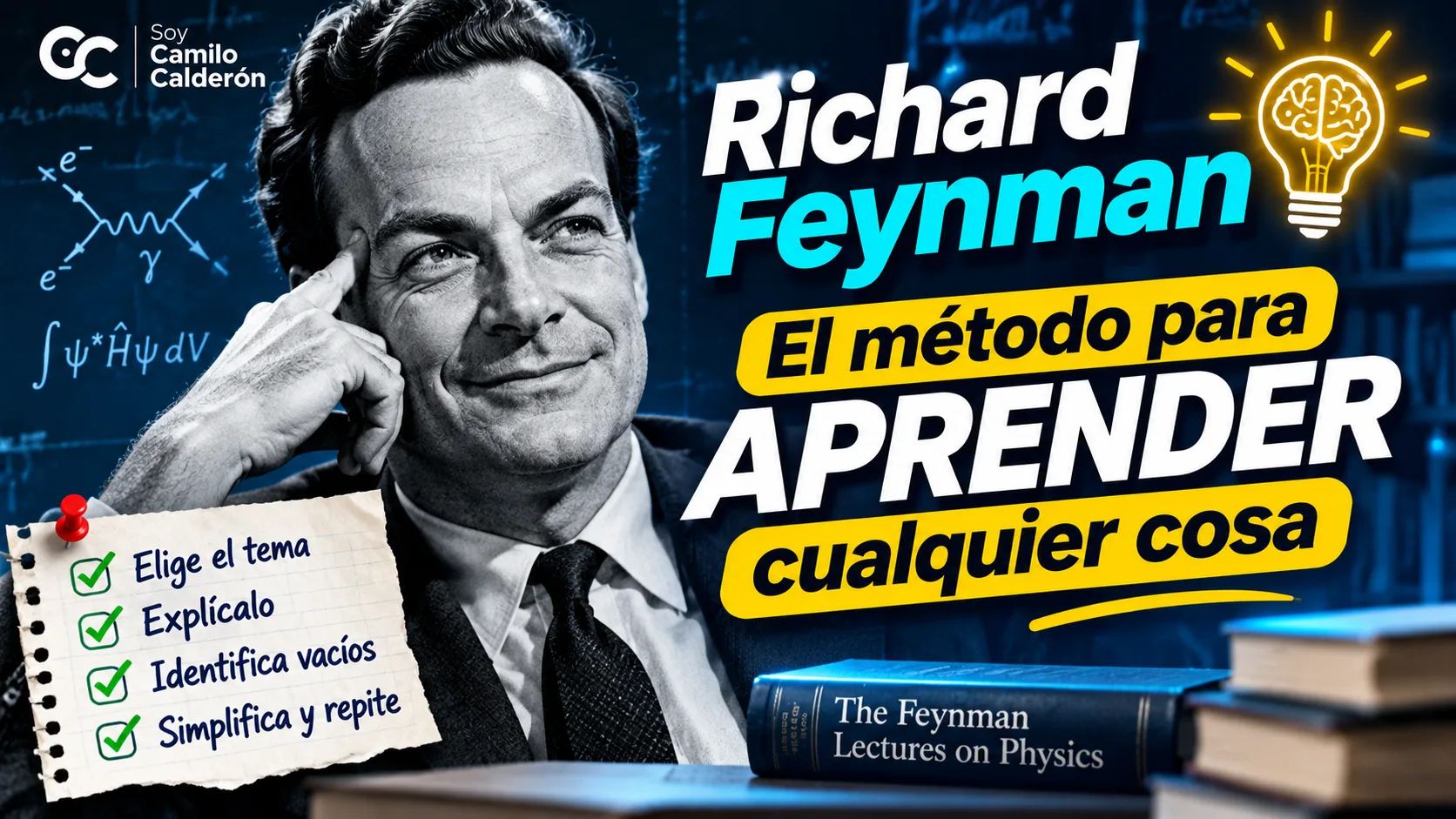
Richard Feynman and the Learning Method of Explaining Ideas in Your Own Words
Have you studied for hours and then discovered that you cannot explain what you read? One learning strategy uses that difficulty to reveal what you still need to understand. Popularly known as the Feynman technique, it is inspired by physicist Richard Feynman’s ability to communicate complex ideas clearly.
Who was Richard Feynman?
Richard Phillips Feynman (1918–1988) was an American theoretical physicist who made important contributions to quantum electrodynamics and received the 1965 Nobel Prize in Physics. He was also known for explaining difficult ideas in accessible language. Understanding a concept involves more than memorizing its definition: it means grasping how it works and communicating its central ideas.
What is the Feynman technique?
The technique is a study strategy: explain a concept in simple words, identify what you do not understand, return to reliable sources, and improve the explanation. If you cannot explain an idea clearly, you may have gaps to investigate. Simplicity should not distort accuracy; technical language is sometimes necessary, but it should be understood rather than used to conceal uncertainty.
The four steps
- Choose a specific concept. Avoid starting with an enormous topic. Instead of explaining all of artificial intelligence, begin with what a language model is.
- Explain it in your own words. Imagine teaching someone who has never encountered the idea. Write or speak without looking at your notes.
- Find the gaps. Notice terms you cannot define, steps you cannot justify, or connections you cannot explain. Write down the questions and return to your study material.
- Simplify and explain again. Organize the explanation and use examples or analogies, checking that they preserve the meaning. Repeat until it is clear and sufficiently precise.
A practical example
Suppose you want to understand short-term memory. A first definition might be: “A cognitive system that keeps information available for a brief period.” You could make the idea more concrete: “It is like a small mental notepad where we temporarily keep information we need, such as repeating a phone number while looking for somewhere to write it down.” Then ask what distinguishes short-term memory from working memory, how long information lasts, and what its limits are. Those questions point to what you should study next.
Is the technique supported by science?
It is useful to distinguish the popular four-step Feynman technique from the learning principles it draws on. There is not enough evidence to claim that this exact complete procedure is superior to every other study method. However, explaining ideas in your own words is related to elaboration and self-explanation, strategies that can help learners connect information and detect gaps. Its value depends on the quality of the explanation and whether you check it against accurate material.
How to use it well
Choose one concept, attempt an explanation from memory, and mark uncertain parts rather than guessing. Consult trustworthy sources, correct misunderstandings, and try again later without notes. Add an example and, when useful, contrast the concept with a similar one. Ask another person to point out unclear steps, but remember that confident feedback can also be mistaken—verify important details.
The technique is not a shortcut that makes every subject effortless. It is a way to turn “I think I understand” into a testable explanation and a list of questions. Use it alongside retrieval practice, spaced review, problem solving, and other methods that fit the material. Learning improves when you notice what you do not yet know and take a deliberate step to close that gap.



CONVERSEMOS
Comentarios (0)
Comparte tu opinión o cuéntanos qué te pareció este artículo.
Todavía no hay comentarios. ¡Puedes iniciar la conversación!