
Aprendizaje y formación · CUADERNO DE IDEAS
Why Does Nobody Help When Everyone Is Watching? The Bystander Effect
Why do some people fail to intervene when they witness an emergency? The bystander effect explains how other people can influence our decision to help. Discover diffusion of responsibility, what psychological research says, and how we can make intervention easier.
LECTURA EN VOZ ALTA
Escucha este artículo
Puedes escucharlo mientras haces otras actividades. Elige una voz y ajusta la velocidad.
Preparado para escuchar.
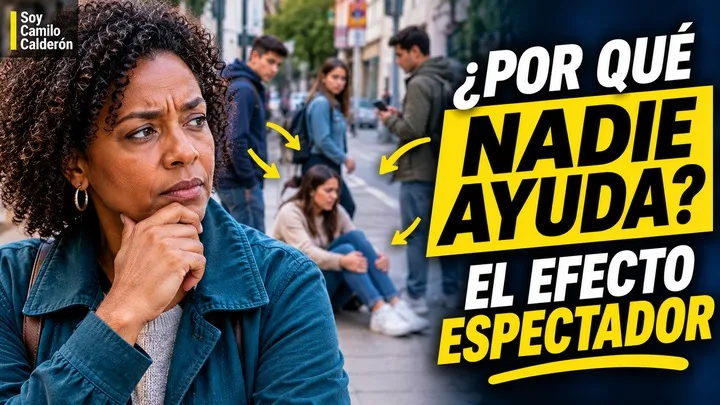
Why Does Nobody Help When Everyone Is Watching? The Bystander Effect
Imagine walking down a busy street and seeing someone who seems to need help. Several people are nearby. Some look over, others keep walking, and a few seem to wait for someone else to intervene.
A few seconds pass, but nobody does anything.
Why does this happen? Does it mean people are indifferent to someone else suffering? Or are there psychological and social processes that can influence our decision to help?
Social psychology studies a phenomenon known as the bystander effect, which helps explain why the presence of other people can reduce the likelihood that an individual will intervene in an emergency.
One mechanism related to this phenomenon is diffusion of responsibility: when several people witness a problem, each may think someone else will take care of it.
However, the explanation is more complex than it seems. To understand it, we need to look at how we interpret emergencies, how other people influence us, and what happens when responsibility for acting seems to be shared by many people.
What Is the Bystander Effect?
The bystander effect is a phenomenon studied in social psychology in which the presence of other people may reduce the likelihood that someone will offer help to a person in need.
Researchers John M. Darley and Bibb Latané were central to the development of this area of research during the 1960s.
In 1968, they published Bystander Intervention in Emergencies: Diffusion of Responsibility, a study analyzing how the presence of other observers influenced the decision to intervene in a simulated emergency.
Their findings showed that participants tended to feel less individual responsibility and took longer to report the emergency when they believed other people were also present.
This finding challenged an intuitive explanation: the more people who witness a problem, the greater the chance that someone will help.
Under certain circumstances, the opposite can happen.
What Is Diffusion of Responsibility?
Diffusion of responsibility is one of the most important psychological mechanisms for understanding the bystander effect.
It occurs when a person perceives that the responsibility to act is shared among several individuals.
Imagine someone fainting in a public place with twenty witnesses.
Someone might think:
- “Surely someone has already called emergency services.”
- “Maybe someone else knows what to do.”
- “I do not want to get involved if it is not necessary.”
- “Someone else must be taking care of it.”
Each person may assume someone else will take responsibility.
The problem arises when several people make the same assumption and nobody acts.
Responsibility seems to be shared by everyone, but no one takes it on directly.
This does not necessarily mean that the people present are unconcerned. They may recognize that something is happening and still feel uncertain about who should intervene.
How Does Other People’s Behavior Influence Us?
Another related mechanism is pluralistic ignorance.
This concept describes a situation in which people use other people’s behavior to interpret an ambiguous event, even though those other people are also confused.
For example, imagine hearing a strange noise and seeing that everyone around you remains calm.
You might interpret this as a sign that nothing important is happening.
However, the other people may be thinking exactly the same thing: if nobody seems concerned, it probably is not an emergency.
In this way, each person’s lack of reaction can reinforce the others’ lack of reaction.
The situation can create a kind of inaction loop.
It is important to distinguish this process from diffusion of responsibility. In the first, people use the group’s apparent calm to interpret what is happening; in the second, they feel that someone else can take care of the intervention.
Both mechanisms can contribute to the bystander effect.
The Five Steps That Occur Before We Help
Darley and Latané developed a decision-making model that helps explain why someone may not intervene in an emergency.
According to this model, helping is not automatic. A person must move through a series of decisions.
1. Notice That Something Is Happening
First, the person must notice the event.
In crowded places, we may be distracted, using our phone, talking, or focused on our own activities.
If we do not notice the situation, it is unlikely that we will intervene.
2. Interpret It as an Emergency
After noticing the event, we need to interpret what is happening.
Someone falling to the ground may have tripped, been injured, or need medical assistance.
When a situation is ambiguous, we may watch other people’s reactions to decide whether there really is a problem.
3. Accept Responsibility for Intervening
This is the step directly related to diffusion of responsibility.
Even when we recognize that someone needs help, we may think another person will take care of it.
The presence of several witnesses can make individual responsibility seem smaller.
4. Decide How to Help
Recognizing an emergency and accepting responsibility do not mean we know what to do.
A person may want to help but be afraid of making a mistake, making the situation worse, or putting themselves in danger.
That is why they also need to consider what kind of intervention is appropriate.
5. Act
Finally, the person needs to carry out the action.
They may call emergency services, ask for help, provide information, or take a safe action based on the circumstances.
At any of these steps, obstacles may delay or prevent help.
What Have Studies Shown About the Bystander Effect?
In one classic study published in 1968, Darley and Latané used an experimental situation in which participants listened to a recording simulating a medical emergency.
The researchers changed how many other people the participants believed could hear the incident.
Some thought they were the only witness; others thought one or several other observers were also present.
The results showed that the perceived presence of other people reduced participants’ sense of individual responsibility and delayed their reporting of the emergency.
Other researchers later expanded the study of this phenomenon.
In 2011, Peter Fischer and colleagues published a meta-analysis titled The Bystander-Effect: A Meta-Analytic Review on Bystander Intervention in Dangerous and Non-Dangerous Emergencies.
The study combined 105 independent effect sizes and data from more than 7,700 participants.
The results supported the general existence of the bystander effect, but also identified conditions that change its strength.
One especially important finding was that the effect was weaker in dangerous situations than in less dangerous emergencies.
This means that the presence of other people does not always reduce helping in the same way. The context, perceived severity, and available ways to intervene also matter.
Why Does the Bystander Effect Not Always Occur?
Although the phenomenon has experimental support, it would be incorrect to say that people never help when others are present.
Helping behavior depends on different factors.
How Clear the Emergency Is
When a situation is obvious, it may be harder to interpret it as something that does not require intervention.
By contrast, when we do not know whether someone needs help, we may watch other people before acting.
The Level of Danger
Emergencies involving clear danger may produce different responses from ambiguous or less serious situations.
The meta-analysis by Fischer and colleagues found that the bystander effect weakened in dangerous situations.
This does not mean we should put ourselves at physical risk, but that features of the emergency can change how people respond.
The Relationship Among Those Present
Being surrounded by strangers is different from being with friends, family, or people we trust.
Group identity, communication, and the sense of responsibility can influence the decision to intervene.
The Ability to Act
When someone knows how to help and believes they can do so safely, they may find it easier to intervene.
By contrast, lack of knowledge, fear of making a mistake, or uncertainty can become obstacles.
How Can We Prevent Diffusion of Responsibility?
Understanding the bystander effect can help us identify strategies that make intervention easier.
One of the best-known recommendations is to direct a request for help to a specific person.
Instead of shouting “Somebody help!”, it may be more effective to point to someone and say:
“You, in the blue jacket, please call emergency services.”
This assigns a specific responsibility instead of leaving it spread among everyone.
Other actions can also help:
- Recognize the situation: do not automatically assume that someone else is already intervening.
- Ask for help clearly: say what is needed and who can do it.
- Contact emergency services: provide the location and describe what is happening.
- Coordinate the people present: assign specific tasks when possible.
- Prioritize safety: do not enter danger that could make you another victim.
Intervention does not always mean taking physical action. In many situations, calling emergency services or getting specialized help is the most appropriate response.
Being Surrounded by People Does Not Guarantee That Someone Will Act
The bystander effect reminds us that human behavior is deeply influenced by social context.
We may think that in an emergency we will always act according to our values and intentions. However, other people’s presence, uncertainty, and perceived responsibility can change our decisions.
This does not mean we are indifferent or that everyone reacts the same way.
It means that helping is also a decision-making process influenced by psychological and social factors.
The next time you witness a situation in which someone needs help, remember that waiting for another person to act may delay an important response.
Sometimes a clear instruction directed at one specific person can make a difference.
Because being surrounded by people does not always mean someone will act.
Further Reading
- Darley, J. M., and Latané, B. (1968). Bystander Intervention in Emergencies: Diffusion of Responsibility. Journal of Personality and Social Psychology, 8(4), 377–383. https://doi.org/10.1037/h0025589
- Latané, B., and Rodin, J. (1969). A Lady in Distress: Inhibiting Effects of Friends and Strangers on Bystander Intervention. Journal of Experimental Social Psychology, 5(2), 189–202. https://doi.org/10.1016/0022-1031(69)90046-8
- Fischer, P. et al. (2011). The Bystander-Effect: A Meta-Analytic Review on Bystander Intervention in Dangerous and Non-Dangerous Emergencies. Psychological Bulletin, 137(4), 517–537. https://doi.org/10.1037/a0023304
Soy Camilo Calderón
Learn. Discover. Evolve.


CONVERSEMOS
Comentarios (0)
Comparte tu opinión o cuéntanos qué te pareció este artículo.
Todavía no hay comentarios. ¡Puedes iniciar la conversación!