
Tecnología e IA · CUADERNO DE IDEAS
AI Voices: How They Are Made, What They Are For, and How to Avoid Scams
Today an AI can speak in your voice from just a few seconds of audio. Here is how it works, how it is used legitimately, and what to do so no one uses it against your family.
LECTURA EN VOZ ALTA
Escucha este artículo
Puedes escucharlo mientras haces otras actividades. Elige una voz y ajusta la velocidad.
Preparado para escuchar.
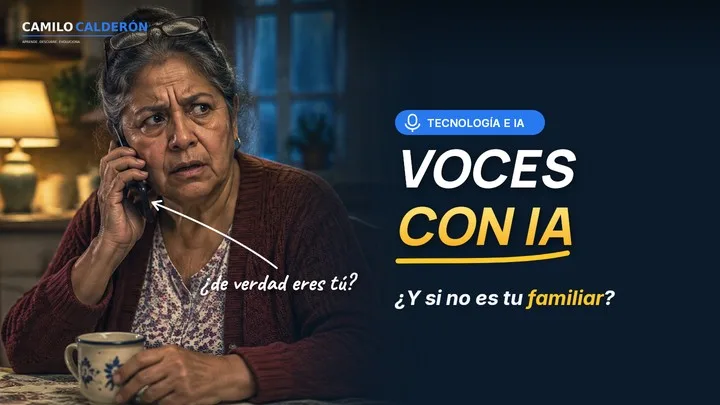
A few years ago, a computer voice was easy to spot: flat, robotic, emotionless. Today you can listen to a full narration without noticing that no one recorded it. Even more striking, an AI can learn to speak in a real person's voice from short audio samples.
This technology opens up very useful possibilities, and also a new door for scammers. In this article I explain how it works, what it is for, and what you can do today to protect yourself.
What an AI voice is
We tend to use the same name for two different things:
- Text to speech: you write a text and the AI reads it with a synthetic voice that does not belong to anyone in particular.
- Voice cloning: the AI listens to recordings of a person and learns to imitate their tone, rhythm and way of speaking. Then it can "say" anything you type in that voice.
Both run on models trained on huge amounts of human speech. That is why they no longer just pronounce words well: they pause, change their intonation, and can sound curious, serious or excited.
Legitimate uses
Creating content
Narration for videos, courses, podcasts and audiobooks. I use a clone of my own voice to narrate the Shorts on this channel: I write the script, review it, and the AI reads it. It saves me hours of recording and retakes.
Accessibility
People who lose their speech to an illness can record their voice beforehand and keep communicating with it. It also helps people who have trouble reading.
Translation and dubbing
The same video can reach other languages while keeping a voice close to the original.
The dark side: cloned-voice scams
The "relative in trouble" scam has been around for years: someone calls, says they are your son or nephew, claims they had an accident or were arrested, and asks for money urgently. What is new is that the voice on the other end can now sound exactly like your relative.
The U.S. Federal Trade Commission (FTC) warned about it in 2023: a scammer only needs a short clip of your relative's voice, which can come from content posted online, and a voice-cloning program.
It does not only happen to older people. In 2019, scammers imitated the voice of the boss of a U.K. energy company and got $243,000 transferred to them.
Not every tool puts up the same barriers, either. In 2025, Consumer Reports evaluated six popular voice-cloning services and found that four of them made it easy to clone a voice from public audio.
How to protect yourself: 5 simple steps
- Do not trust the voice alone. If someone calls you with an emergency, hang up and call the number you already have saved for that person.
- Create a family code word. A word or phrase only you know, to be said in any emergency call. If they do not know it, it is not your relative.
- Be wary of urgency and secrecy. "Don't tell anyone" and "I need the money now" are the clearest signs of a scam, far more than a robotic sound.
- Ask questions only that person can answer. Something recent and private, not a detail that appears on social media.
- Talk about this with your parents and grandparents. They are the most frequent targets. Five minutes of conversation can prevent a big loss.
If you are going to create AI voices
- Clone only your own voice, or that of someone who has given you written permission.
- Do not imitate celebrities or real people to make them say things they never said.
- When you publish, be transparent: saying a voice is AI-generated builds trust, it does not take it away.
- Always review the full audio before publishing. AI also gets names and numbers wrong.
Technology is not the problem
AI voices are a tool, like a hammer or a phone. Used well, they save time, give a voice back to those who lost it, and bring knowledge to more people. The risk lies in using them to deceive, and the best defense is not technological: it is a simple habit, like verifying before acting.
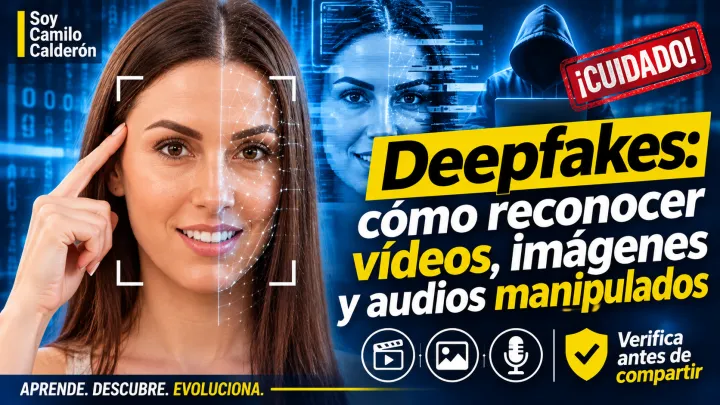
If you want to keep learning, read Deepfakes: how to spot manipulated videos, images and audio and watch What you should never share with artificial intelligence.

CONVERSEMOS
Comentarios (0)
Comparte tu opinión o cuéntanos qué te pareció este artículo.
Todavía no hay comentarios. ¡Puedes iniciar la conversación!