
Ideas y experimentos · CUADERNO DE IDEAS
Can Your Brain Feel That a Rubber Hand Belongs to You? The Experiment That Challenges Perception
Imagine watching a rubber hand being stroked while feeling the touch on your own hidden hand. Could your brain begin to feel that the artificial hand is part of your body? Discover one of the most surprising experiments in perception psychology.
LECTURA EN VOZ ALTA
Escucha este artículo
Puedes escucharlo mientras haces otras actividades. Elige una voz y ajusta la velocidad.
Preparado para escuchar.
Can Your Brain Feel That a Rubber Hand Belongs to You? The Experiment That Challenges Perception
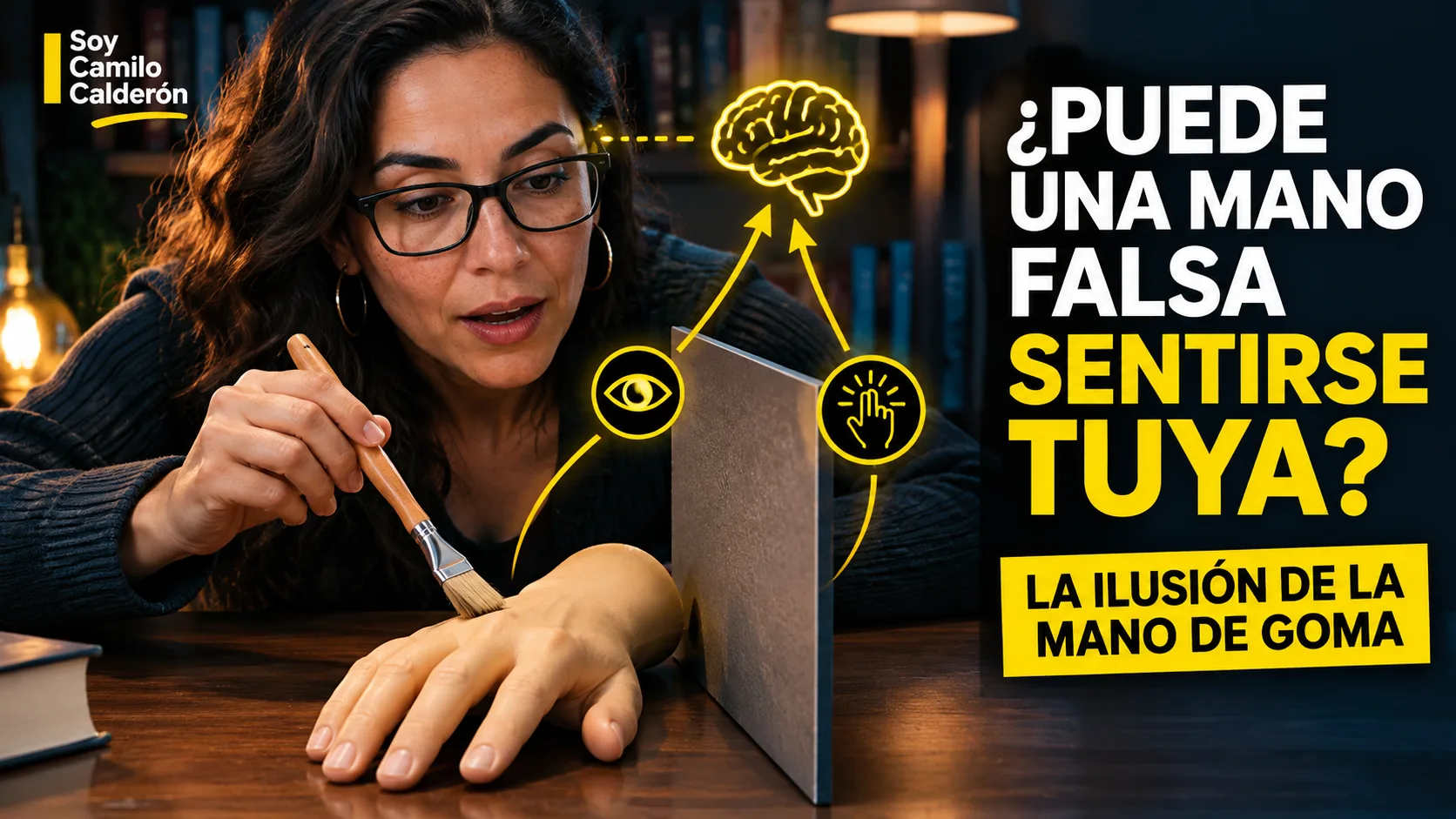
Imagine sitting at a table. Your left hand is hidden behind a small screen, while an artificial hand that looks quite real sits in front of you.
Someone gently brushes the fingers of the rubber hand. At the same time, you feel another brush touching the fingers of your real hand, even though you cannot see it.
The movements happen at exactly the same time.
After a while, something rather strange might happen: you begin to feel that the touch you see is happening on the artificial hand, as if it were actually part of your body.
Could your brain really experience something like this?
This is not magic or hypnosis. It is a perceptual illusion known as the rubber hand illusion, one of the most interesting experiments in perception psychology and research on the sense of body ownership.
1. The Experiment: A Hand That Is Not Yours Can Feel Like Your Own
The rubber hand illusion was famously studied by researchers Matthew Botvinick and Jonathan Cohen, who published their findings in the scientific journal Nature in 1998.
Their paper, titled Rubber hands “feel†touch that eyes see, explored how visual and tactile information can influence our perception of our own bodies.
The procedure was simple but ingenious.
Participants placed one hand on a table, hidden from view by a screen. An artificial hand was placed in front of them in a position that visually matched the real hand.
A researcher then used two brushes to stroke the same areas of both hands at the same time.
The participant could watch the brush touch the artificial hand while feeling the corresponding touch on the hidden hand.
Synchronization was essential.
When what participants saw matched what they felt in time, some began to experience the illusion that the artificial hand was part of their own body.
Interestingly, the hand did not need to be physically connected to the person for this perceptual experience to occur.
2. Why Does This Illusion Happen?
To understand the experiment, we need to know three concepts related to our senses.
Vision
This is the information we receive through our eyes.
In this experiment, the participant sees an artificial hand and exactly where and when it is being touched.
Touch
This is the information we receive through sensory receptors in the skin.
Although the person cannot see the real hand, they can feel the brush moving over it.
Proprioception
This is the ability to perceive the position and movement of our body without having to look at it directly.
Thanks to proprioception, you can tell where your hand is even when you close your eyes.
Normally, these sources of information work together to help us build a coherent representation of the body.
But the experiment creates a special situation: the person sees an artificial hand and receives simultaneous tactile sensations on the real hand.
When both signals match, the brain may combine them in a way that temporarily changes the perceived location of the touch and which hand seems to be receiving it.
The illusion shows that our experience of the body does not depend only on visual or tactile information separately, but also on how different sensory signals are combined.
3. Try a Simple Version at Home
Now that we understand the idea, we can try a demonstration inspired by the original experiment.
You do not need a professional laboratory, but you will need a few materials and another person to help.
Materials:
- A realistic-looking artificial hand, preferably about the same size as your own.
- A small cardboard screen or a sturdy folder.
- Two soft brushes.
- A table.
- Help from another person.
Setup:
- Sit at a table and place one hand behind the screen so you cannot see it.
- Put the artificial hand in front of you, in roughly the same position and orientation as the hidden hand.
- Ask another person to use one brush to gently touch the artificial hand and another to touch your real hand.
- Keep looking at the artificial hand.
First round: synchronized movements.
Your helper should try to move both brushes at the same time and touch corresponding areas.
For example, when the brush touches the index finger of the artificial hand, the other brush should touch your real index finger at the same time.
Continue for a short time and observe what happens.
Second round: unsynchronized movements.
Repeat the procedure, but this time the brushes should touch the two hands at different times.
Then compare the two experiences.
You can ask yourself:
- During which round did you feel the touch more clearly?
- Did your attention begin to shift toward the artificial hand?
- Did you experience any sense of body ownership?
- Did you notice differences between synchronized and unsynchronized movements?
An important clarification: this is a home demonstration inspired by the experimental paradigm, not a standardized reproduction of the original study. The quality and position of the artificial hand and the precision of the stimuli may affect the result.
Not everyone experiences the illusion, and not feeling it does not mean there is anything wrong with your perception.
Use only soft brushes and avoid painful or sharp stimuli.
4. What Did the Researchers Discover?
The work by Botvinick and Cohen made it possible to study a fundamental question: how do we build the experience that a part of our body belongs to us?
Under synchronized stimulation, some participants described sensations consistent with experiencing the artificial hand as their own.
Comparing this with unsynchronized movements was also important: when the visual and tactile information did not match in time, the illusion tended to weaken.
This allowed researchers to explore the role of multisensory integration in body perception.
There is an interesting detail, however: not all measures used to study the illusion represent exactly the same experience.
For example, researchers may ask whether a person felt that the artificial hand was theirs or measure whether the perceived position of their real hand changed.
A study published in 2011 showed that the subjective feeling of ownership and the shift in perceived hand position do not always coincide.
This means that researchers can study different components of the illusion without assuming they all describe one psychological process.
Body experience is more complex than it may seem.
5. What Does This Experiment Teach Us About the Brain?
The rubber hand illusion is interesting because it challenges an idea we usually take for granted: that we always have a completely fixed and direct perception of our own body.
In reality, the body representation uses information from different sources.
Vision helps us identify where a body part is. Touch tells us about physical contact, and proprioception helps us estimate its position.
When these signals are combined in a particular way, our experience can change.
This does not mean the brain constantly confuses a real hand with an artificial one.
It means that body perception is an active process in which the nervous system combines information to construct a coherent experience of the body.
That is precisely why this experiment remains so interesting to psychology and neuroscience.
6. What Is the Value of Researching This Illusion?
Beyond being a striking experiment, the rubber hand illusion has made it possible to study questions about body representation and how different senses interact.
One of its most interesting research applications relates to prostheses.
Scientists study how a person may come to experience an artificial device as part of the body and what role sensory information plays in that process.
For example, a prosthesis that not only enables movement but also provides tactile information raises important questions about how the brain may integrate those signals.
Research on the rubber hand illusion provides tools for studying these processes. This does not mean the experiment alone guarantees that a person will accept or feel that any prosthesis is their own.
Its value is in helping us better understand the mechanisms involved in body experience.
7. What This Experiment Does Not Show
It is important not to draw exaggerated conclusions.
The rubber hand illusion does not show that we can replace any body part through simple suggestion.
It also does not mean the brain can be fooled in any way or that everyone experiences exactly the same thing.
It shows something more specific and scientifically interesting: under certain conditions, integrating visual and tactile signals can temporarily change the experience of body ownership.
We should also remember that a laboratory experiment studies a controlled situation. Its results should not automatically be applied to every everyday experience.
Understanding the limits of research is as important as knowing its findings.
Conclusion: Your Experience of Your Body Is More Interesting Than You May Imagine
The rubber hand illusion lets us observe how vision, touch, and proprioception contribute to our experience of the body.
An artificial hand, two brushes, and a screen can become tools for studying one of the most fascinating aspects of human perception: how we feel that our body belongs to us.
Perhaps the most interesting question is not whether we can fool the brain, but how it combines so many different signals to give us a relatively coherent experience of ourselves.
The next time you look at your hands, remember that the feeling that they are yours is also the result of an extraordinarily complex perceptual process.
Scientific and educational content for general audiences. The demonstration described is an illustrative activity inspired by an experimental paradigm; it is not a diagnostic test or an assessment of a person’s sensory abilities.



CONVERSEMOS
Comentarios (0)
Comparte tu opinión o cuéntanos qué te pareció este artículo.
Todavía no hay comentarios. ¡Puedes iniciar la conversación!