
Ideas y experimentos · CUADERNO DE IDEAS
The Stroop Effect: Can You Name the Color Without Reading the Word?
Try to identify a color without being distracted by the word beside it. This simple demonstration introduces the Stroop effect and what it reveals about attention and competing mental processes.
LECTURA EN VOZ ALTA
Escucha este artículo
Puedes escucharlo mientras haces otras actividades. Elige una voz y ajusta la velocidad.
Preparado para escuchar.
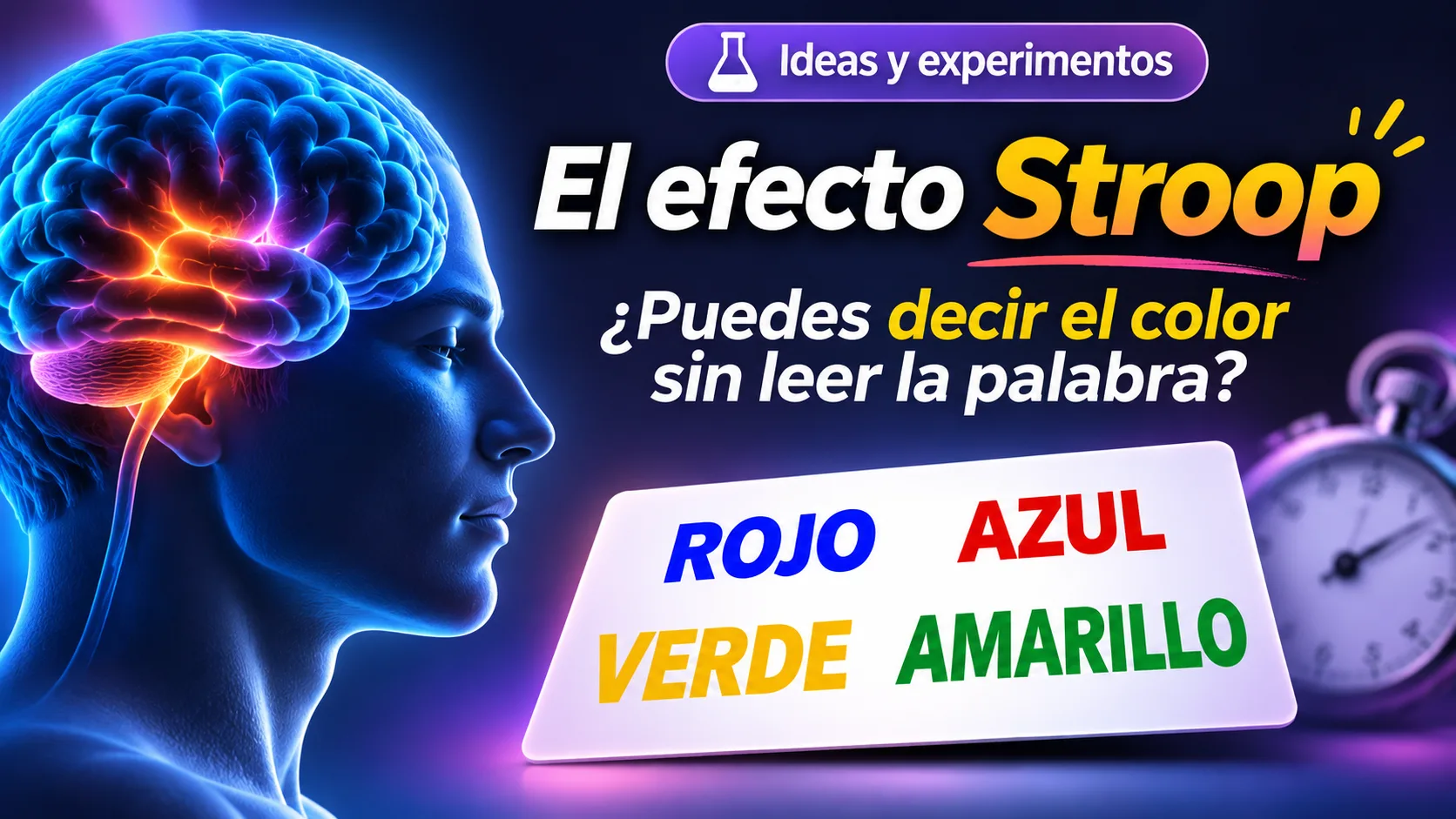
The Stroop Effect: Can You Name the Color Without Reading the Word?
Imagine someone shows you a word and asks you not to read it, but only to name the color in which it appears. You understand the instruction, yet when the word and color conflict, responding can become slower and errors more likely. This familiar phenomenon is called the Stroop effect.
1. Try a small attention demonstration
First name a sequence of colored squares aloud, from left to right. Then repeat the task while ignoring color words shown beside the squares. Many people find the second round less comfortable because the word competes for attention. This is a simplified demonstration inspired by Stroop tasks; the classic experiment prints color words in ink that conflicts with their meaning. It is not a standardized test and cannot evaluate your attention or diagnose a condition.
2. What is the Stroop effect?
The Stroop effect is cognitive interference that occurs when two features of a stimulus provide competing information. For example, the word BLUE printed in red ink activates its meaning while the task asks you to name the ink color. The word points to blue and the ink points to red. You may know exactly what to do and still experience interference, because reading a familiar word is highly practiced and happens quickly.
3. John Ridley Stroop’s 1935 study
Psychologist John Ridley Stroop published “Studies of Interference in Serial Verbal Reactions” in 1935. He examined how naming the color of ink could be disrupted by the word’s meaning, and how reading could be affected by color. Participants generally took longer to name ink colors when the printed word named a different color than when the stimulus did not create that conflict. The effect became an influential way to study interference and selective attention.
4. Why does the conflict happen?
Reading is an overlearned process for many literate adults. When you see a familiar word, its meaning is activated with little deliberate effort. Naming an ink color, by contrast, is the task you must intentionally carry out. These responses compete, and you need to prioritize the relevant feature while suppressing the distracting one. This does not mean the brain has a single attention switch; performance reflects interacting processes, the task, and the person’s experience.
5. What can the effect tell us about attention?
The task illustrates that attention is not simply a matter of deciding what to notice. Information we do not intend to use can still influence a response. It also shows that conflict can affect speed and accuracy. Researchers use variations of Stroop tasks to investigate cognitive control, interference, and how people respond to competing demands. Results depend on factors such as language, age, reading ability, stimulus design, and practice.
6. What the Stroop effect does not prove
A single demonstration cannot measure a person’s general intelligence, diagnose ADHD, or establish a brain disorder. Taking longer on a color-word task may reflect many things, including familiarity with the words, color vision, language, fatigue, and the exact procedure. Research tasks can contribute evidence when administered and interpreted appropriately, but a viral exercise is not a clinical assessment.
7. Everyday examples of interference
Competing information appears in ordinary life: a notification interrupts reading, a familiar routine competes with a new instruction, or a word on a sign captures attention when you are trying to notice its color or position. The Stroop effect offers a controlled example of how automatic and deliberate processes can collide. It does not mean we have no control; rather, directing attention may require effort, especially when the distracting response is strong.
The next time your mind responds to information you meant to ignore, remember that attention involves competition as well as intention. The Stroop effect is a useful demonstration of that tension—and a reminder that knowing the instruction does not always make the competing signal disappear.



CONVERSEMOS
Comentarios (0)
Comparte tu opinión o cuéntanos qué te pareció este artículo.
Todavía no hay comentarios. ¡Puedes iniciar la conversación!